


What causes presbyopia?
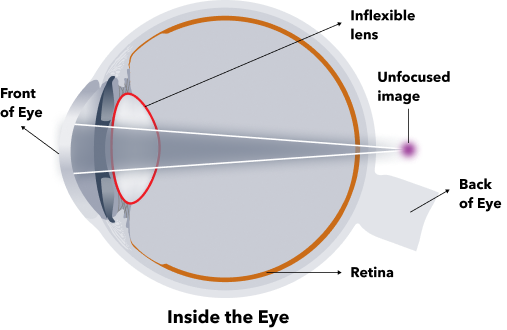
Presbyopia is caused by changes in the eye due to aging. These changes usually happen around age 40, when the lens in our eyes begins to stiffen. Over time, this stiffening makes it harder to focus on close-up objects like text messages, menus, or small print.
Less common causes of presbyopia can include certain health conditions, some medicines, and eye injury or surgery.
Does everyone get presbyopia?
Yes, almost everyone will get presbyopia as they age. In fact, 9 in 10 adults over age 45 in the US have presbyopia, per the American Optometric Association.

What are the signs and symptoms of presbyopia?
The common signs and symptoms of presbyopia include:

Headaches: You may feel a headache after reading for periods of time

Eye strain: Your eyes may feel tired after working on close-up tasks, such as using a computer

Dizziness: You may feel slightly off or unsteady with blurry close-up vision

Difficulty seeing at night: You may have trouble seeing clearly while driving at night

Trouble seeing in dim lighting: Reading in a dimly lit room may be harder
What are the differences between presbyopia, hyperopia, and myopia?
- Presbyopia is age-related, blurry close-up vision due to the lens of the eye stiffening.
- Hyperopia, or farsightedness, is when you can see far away better than close up. This can happen at any age.
- Myopia, or nearsightedness, is when you can see close up better than far away. This can also happen at any age.
You can have more than one of these vision problems at the same time. For example, you can be “nearsighted” and have presbyopia.
Over time, the lens in your eye stiffens. This makes it harder to focus on close-up objects.
What are the available presbyopia treatment options?

Glasses: These may include reading glasses, bifocals, or progressive lenses, some of which require a prescription

Contact lenses: Options may include multifocal or monovision contacts to help with near vision

Surgical procedures: These can help reshape the eye or replace the lens

Prescription presbyopia eye drops, such as YUVEZZI, are a less invasive step you can take instead of surgery
Want to explore your options? Download this guide to help start the conversation with an eye doctor.
Does presbyopia get worse with age?
Yes, presbyopia can get worse with age, although it depends on the person. For most people, presbyopia happens around age 40. For some people, presbyopia may stop getting worse after a few years. For others, it may worsen into their late 60s or beyond and require stronger eyeglass prescriptions as they age.